Meridian massage is a broad term used to describe massage and bodywork that follows the channel system of Chinese medicine.
Rather than focusing only on individual muscles, meridian-based bodywork considers how tension, tenderness and restriction may relate to the pathways known in Chinese medicine as the Jing Luo (经络) — the channels and connecting vessels through which Qi and Blood are traditionally understood to circulate.
The term "meridian massage" is not one single classical technique. It is more commonly used as a modern umbrella term for bodywork influenced by systems such as Tui Na, acupressure, Shiatsu and other East Asian manual therapies.
The defining feature is that treatment is organised partly around the channels, acupuncture points and patterns of Chinese medicine, rather than anatomy alone.
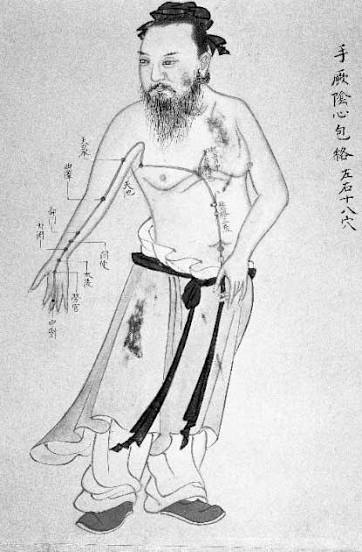
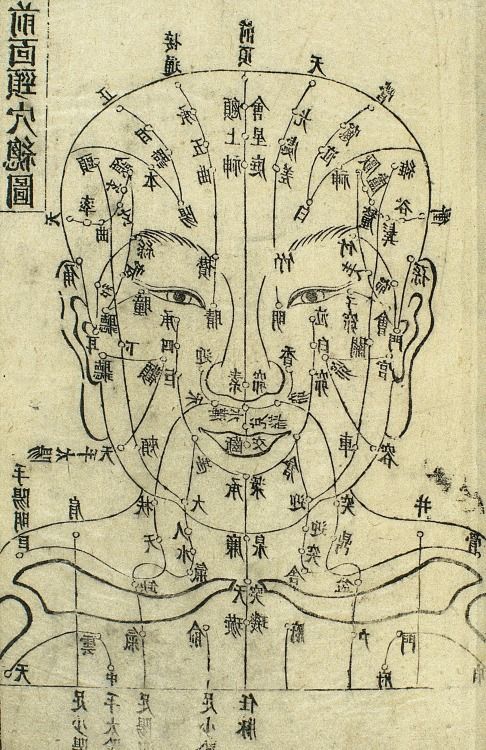
A historical meridian chart — the traditional channel pathways that meridian massage follows.
What Are Meridians?
The word "meridian" is the common English translation used for the Chinese medicine concept of Jing Luo 经络. A more accurate translation is often channels and collaterals.
Jing 经 refers primarily to the major channels.
Luo 络 refers to the smaller connecting vessels and networks.
Within traditional Chinese medicine, these pathways connect different areas of the body and provide a framework for understanding the movement of:
Qi 气
Blood — Xue 血
nourishment
sensation
functional relationships between different regions of the body
The channel system is also the framework used in acupuncture. A practitioner performing meridian massage may therefore work along the same pathways used to locate acupuncture points — but instead of needles, the treatment is applied through the hands.
The Twelve Primary Channels
Chinese medicine describes twelve primary channels, traditionally associated with the Zang Fu organ systems. These are:
Lung — Fei 肺
Large Intestine — Da Chang 大肠
Stomach — Wei 胃
Spleen — Pi 脾
Heart — Xin 心
Small Intestine — Xiao Chang 小肠
Bladder — Pang Guang 膀胱
Kidney — Shen 肾
Pericardium — Xin Bao 心包
San Jiao — San Jiao 三焦
Gallbladder — Dan 胆
Liver — Gan 肝
These channels travel through particular areas of the body. For example, the Bladder channel runs along the posterior body and legs, the Gallbladder channel travels along the lateral side of the body, while the Stomach channel follows much of the anterior body and legs.
This gives meridian massage a different map of the body from a purely muscular treatment.
Meridian Massage and Qi
One of the central ideas in Chinese medicine is Qi 气. Qi is difficult to translate directly into English — depending on the context, it can refer to functional activity, movement, vitality or physiological processes described through the traditional Chinese medicine model.
Chinese medicine states:
Bu Tong Ze Tong — 不通则痛
Often translated as:
"When there is no free flow, there is pain."
This idea is particularly relevant to manual therapy. When Qi and Blood are considered to be moving poorly through an area, a Chinese medicine practitioner may describe this as Qi Zhi 气滞 — Qi stagnation or Xue Yu 血瘀 — Blood stasis.
Meridian massage may use pressure, stretching, kneading and rhythmic movement with the traditional treatment intention of encouraging freer movement through the channels.
What Happens During a Meridian Massage?
A meridian massage treatment can vary considerably depending upon the system being used. A practitioner may use:
palm pressure
thumb pressure
kneading
rubbing
stretching
rocking
joint movement
sustained acupressure
work along entire channel pathways
Some treatments may be quite gentle, while others involve stronger pressure. Rather than working randomly through areas of tension, the practitioner may follow a particular channel or group of channels.
For example, if tension is present through the neck and posterior shoulder, treatment may include areas corresponding with the Bladder, Small Intestine or Gallbladder channels, depending upon the location and presentation.
Acupuncture Points Without Needles
Meridian massage often includes stimulation of Xue Wei (穴位) — acupuncture points. The points used are essentially the same locations used in acupuncture, although they are stimulated manually. This is usually called acupressure when pressure is applied directly to individual points.
Some familiar examples include:
LI4 — Hegu 合谷: on the hand between the thumb and index finger. An important point of the Large Intestine channel, traditionally described as strongly moving Qi.
ST36 — Zusanli 足三里: on the lower leg. Traditionally used to support Qi and Blood and regulate the Stomach and Spleen systems.
PC6 — Neiguan 内关: on the inner forearm. Belongs to the Pericardium channel and is traditionally associated with regulating the chest, calming the Shen and harmonising the Stomach.
GB20 — Fengchi 风池: near the base of the skull. Frequently included in treatments involving the neck and head.
A meridian massage does not necessarily require these exact points, but point stimulation often forms part of the treatment.
Channel pathways travelling through the limbs and trunk give meridian massage a different map of the body.
Meridian Massage and the Zang Fu
The organ names used in Chinese medicine have broader meanings than the anatomical organs alone. The Zang Fu 脏腑 system describes functional relationships within the body.
For example, the Chinese medicine concept of the Spleen — Pi 脾 relates not only to the physical spleen but to a wider functional model involving digestion, transformation and transportation. Similarly, Liver — Gan 肝 includes traditional functions relating to the free movement of Qi.
This means working on a particular channel is not necessarily intended to physically manipulate the anatomical organ associated with its name. The names belong to the theoretical language of Chinese medicine.
Meridian Massage and Tui Na
Tui Na 推拿 is one of the main traditional Chinese manual therapies and has a particularly close relationship with meridian massage. Tui Na practitioners work with:
Jing Luo 经络 — channels and collaterals
Xue Wei 穴位 — acupuncture points
Qi and Blood 气血
Zang Fu 脏腑
Bian Zheng 辨证 — pattern differentiation
Tui Na also includes specialised manual techniques known as Shou Fa 手法, including Tui Fa 推法 — pushing, Na Fa 拿法 — grasping, An Fa 按法 — pressing, Rou Fa 揉法 — kneading, Gun Fa 滚法 — rolling and Mo Fa 摩法 — circular rubbing.
Meridian massage may borrow from these techniques, although not every treatment described as meridian massage should automatically be considered formal Tui Na.
Meridian Massage and Shiatsu
Shiatsu also works extensively with channels. Traditional Japanese Shiatsu developed partly from older East Asian massage traditions and uses sustained pressure, stretching and movement through the body.
Some styles of Shiatsu work closely with the classical acupuncture channels, while others use expanded channel systems. For this reason, a Shiatsu treatment can feel similar to what people describe as meridian massage.
The main difference is that Shiatsu is a distinct Japanese therapeutic tradition, whereas "meridian massage" is a broader descriptive term.
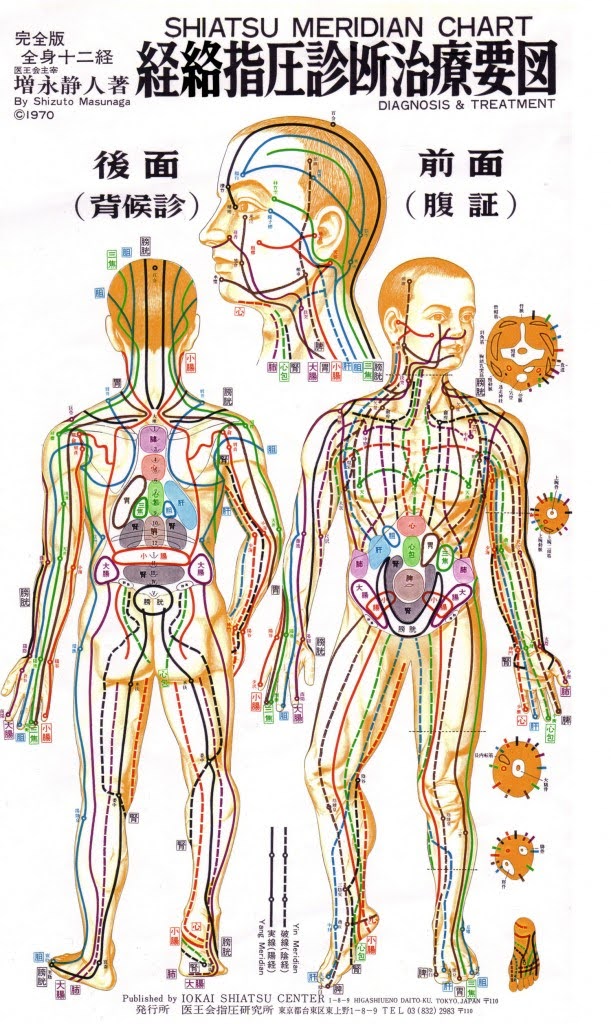
Shizuto Masunaga's extended meridian system — one of the expanded channel maps used in Japanese Shiatsu.
Following a Channel Rather Than a Muscle
Imagine someone experiences tension running from the side of the neck into the shoulder and down the outer arm.
A conventional massage approach might primarily consider the trapezius, deltoid, rotator cuff and surrounding fascia. A meridian-based practitioner can still consider all of these structures — however, they may also observe that the area overlaps with particular Chinese medicine channel pathways.
Treatment might therefore extend further along the arm or into the hand rather than staying directly at the shoulder. This is one of the reasons acupuncture and meridian-based therapies sometimes work at locations away from where a person initially experiences tension.
Channel Palpation
An important aspect of good East Asian bodywork is palpation. The practitioner does not necessarily assume that every part of a channel requires treatment simply because a symptom is located nearby.
The channel can be palpated for changes such as tenderness, muscular tension, areas that feel unusually soft, temperature differences, restriction or sensitivity. These findings can help determine where treatment is focused.
In Japanese acupuncture and Shiatsu traditions in particular, palpation can become an important part of the diagnostic process.
Pattern Differentiation
A more traditional Chinese medicine approach may also incorporate Bian Zheng 辨证 — pattern differentiation, which asks what underlying relationship may be contributing to the presentation.
For example, tension could theoretically occur alongside patterns described as Qi stagnation, Blood stasis, Wind-Cold-Damp obstruction, deficiency of Qi, deficiency of Blood, or imbalance between particular Zang Fu systems.
This does not mean that every massage treatment requires a formal Chinese medicine diagnosis. However, the more closely the practitioner follows classical Chinese medicine, the more treatment tends to be guided by the quality and pattern of the presentation, rather than simply pressing wherever something feels tight.
Excess and Deficiency
Chinese medicine commonly distinguishes between excess and deficiency. An area that feels hard, tight and strongly tender may be interpreted differently from an area that feels weak, empty or chronically fatigued. The treatment technique can therefore change.
A more excess presentation may traditionally involve stronger moving or dispersing methods, while a deficient presentation may be treated with slower, gentler or more supportive techniques.
This is one reason effective meridian massage should not simply mean applying very strong pressure along every channel.
What Does Meridian Massage Feel Like?
The experience depends on the practitioner and style. It can include a combination of:
Broad pressure — palms or forearms along larger areas of the body.
Specific acupressure — thumbs or fingers on individual acupuncture points.
Channel work — pressure progressing along a channel pathway.
Stretching — limbs or trunk moved to open different areas.
Rocking and mobilisation — gentle movement around joints.
Palpation — the practitioner repeatedly assesses the tissues and modifies the treatment according to how the body responds.
A good treatment does not need to be painful to be effective.
Is Meridian Massage Scientific?
The meridian system belongs to the traditional theoretical framework of East Asian medicine. It should not be presented as though meridians have been conclusively demonstrated to be anatomical tubes or physical structures equivalent to nerves or blood vessels.
Research continues into the physiological effects of massage, manual therapy, acupressure and acupuncture, but these modern investigations are different from the classical Chinese concept of Jing Luo. For this reason, it is useful to keep the two frameworks distinct.
Chinese medicine describes treatment using concepts such as Qi, Blood, channels, Yin and Yang, Zang Fu and pattern differentiation. Modern biomedical research instead examines things such as nervous-system responses, pain modulation, circulation, muscular tone, connective tissue and relaxation responses. These are different explanatory models.
That said, some modern researchers have asked whether aspects of the channel system might correspond with connective tissue and the interstitial layers of the body. In an ultrasound-based study published in The Anatomical Record (2002), Langevin and Yandow found that a large majority of acupuncture points and meridian pathways correspond closely with planes of connective tissue between and within muscles. The authors proposed that the network of connective tissue — rather than a series of separate anatomical tubes — may represent one physical substrate relevant to the traditional channel system.
More recently, a study published in Scientific Reports (2018) described a widespread, fluid-filled interstitial network of collagen bundles running through many tissues of the body. Some commentators have since drawn parallels between this network and traditional descriptions of the San Jiao (Triple Burner) and the movement of fluids through the channels. It is worth noting that the study's authors did not make that claim themselves, and no research has demonstrated that meridians are this network.
Reviews examining the "fascial hypothesis" of acupuncture points and meridians continue to be published — for example, work by Bai and colleagues in the Journal of Acupuncture and Meridian Studies (2011). These studies do not prove the traditional channel system in a biomedical sense. What they suggest is that fascia and the interstitial spaces are an active research frontier, and that manual therapies — including meridian-based massage — are increasingly studied through their effects on connective tissue.
The classical framework of Jing Luo and the biomedical framework remain distinct, but they may eventually describe overlapping territory.
What Is Meridian Massage Used For?
People commonly seek meridian-based bodywork for:
muscular tension
stiffness
stress
general relaxation
neck and shoulder tension
back tension
reduced comfortable movement
fatigue
general wellbeing
The treatment should not be considered a substitute for appropriate medical assessment where symptoms are severe, unexplained or persistent.
Meridian Massage in Melbourne
At Back to Breath Shiatsu in Melbourne, treatment is influenced by the channel-based traditions of East Asian medicine. Shiatsu naturally incorporates pressure along the body, channel pathways, acupressure points, stretching and movement.
Depending upon what is found during the treatment, techniques influenced by Shiatsu, Tui Na and Chinese medicine channel theory may be used together. The intention is not simply to apply pressure to the most painful area — treatment looks at how different regions of the body connect and where tension or restriction may be occurring along those pathways.
Let me know whether Saturday or Tuesday suits you, and whether you prefer morning or afternoon. I’ll confirm a date and time by email.
A Different Way of Looking at the Body
Perhaps the simplest way to understand meridian massage is that it uses a different map of the body. Western anatomy gives us muscles, nerves, joints and connective tissue. Chinese medicine adds another traditional map: Jing Luo 经络 — the channels and collaterals. A practitioner can consider both.
Instead of seeing a painful shoulder purely as an isolated muscle, meridian-based bodywork asks how that area relates to the neck, back, arm, hand and the channel pathways travelling through them.
This whole-body perspective is one of the defining characteristics of Shiatsu, Tui Na, acupressure and meridian massage.
Book a Shiatsu treatment in Melbourne CBD
Let me know whether Saturday or Tuesday suits you, and whether you prefer morning or afternoon. I’ll confirm a date and time by email.