What Is Sotai? A Gentle Japanese Approach to Movement, Tension and Balance
Posted 27 July 2026
Sotai — also known as Sotai Ho — is a Japanese system of gentle movement therapy that uses comfortable movement, breath and light resistance to explore imbalance and tension in the body.
Unlike approaches that attempt to stretch or force a restricted area directly, Sotai often works in the opposite way. The body is first guided towards the direction that feels easier, more comfortable and more natural.
This simple idea can make Sotai an interesting addition to Shiatsu and Japanese bodywork, particularly when someone feels stiff, restricted or uneven in the way they move.
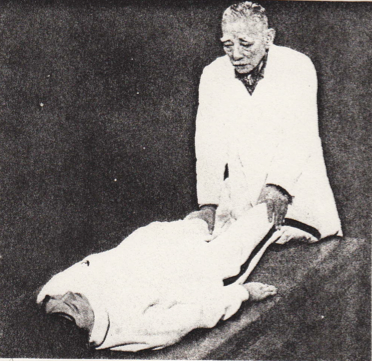
Dr Keizo Hashimoto (1897–1993), the Japanese physician who developed Sotai.
What Is Sotai?
Sotai was developed in Japan by physician Dr Keizo Hashimoto (1897–1993). Hashimoto became interested in the relationship between posture, movement and physical discomfort and developed a system based around restoring more comfortable patterns of movement.
One of the central principles of Sotai is surprisingly simple:
Rather than repeatedly moving into the direction that hurts or feels restricted, explore the direction that feels easier.
A practitioner may compare movements from side to side — such as rotating the hips, moving the shoulders, bending the knees or turning the head — and observe where movement feels comfortable and where it feels restricted.
The easier movement can then be performed slowly while the practitioner provides gentle resistance. After several seconds, the resistance is released and the body relaxes. The movement is then reassessed. Sometimes the previously restricted movement feels different immediately.
Moving Towards Comfort Rather Than Pain
One thing that distinguishes Sotai therapy from many stretching approaches is its emphasis on comfort.
Imagine turning your head to the left feels restricted while turning to the right feels easy. The instinctive response might be to repeatedly stretch towards the restricted left side. Sotai may instead work with the comfortable movement towards the right.
The practitioner provides gentle resistance while you move towards the easier direction. You breathe, allow the movement to occur without strain and then completely release the muscular effort. The movement is subsequently tested again.
The aim is not to force the body into a theoretically perfect position. Instead, Sotai uses comfortable movement as a way of encouraging the body to reorganise its own muscular holding patterns. This makes the treatment feel quite different from aggressive stretching or manipulation.
What Does a Sotai Treatment Feel Like?
Sotai is generally gentle. During a session you may be asked to make simple movements with your:
legs and hips
feet and ankles
shoulders
arms
pelvis
spine
neck
The practitioner may ask:
"Which direction feels easier?"
This question is important. Sotai places considerable attention on the person's own perception of their body rather than relying entirely on what the practitioner sees from the outside.
Once a comfortable direction has been identified, the practitioner may apply light resistance while you slowly move into it. You are not trying to overpower the practitioner — the resistance simply gives the nervous and muscular systems something to work against. The movement remains comfortable, breathing stays relaxed, and after a brief period the effort is released.
The Role of the Sudden Release
An interesting component of classical Sotai is the transition from gentle muscular effort into relaxation.
The practitioner provides resistance while the client moves comfortably against it. At an appropriate moment, the resistance is removed and the person releases the effort. There is often then a brief period of rest. Rather than immediately performing another movement, the body is given time to settle.
This combination of comfortable movement, resistance, breath and release is one of the characteristic features of Sotai.
Sotai and Shiatsu
Sotai and Shiatsu developed as distinct Japanese therapeutic approaches, but they can complement one another very naturally.
Shiatsu primarily uses pressure, stretching, movement and contact with the body to encourage relaxation and work with areas of tension. Sotai introduces a more active element. Instead of receiving the entire treatment passively, the client participates in particular movements.
For example, during a Shiatsu session I might notice that one hip moves considerably more freely than the other. Rather than simply stretching the restricted hip, we can explore the movement through a Sotai lens:
Which direction actually feels easiest?
We can then work with that comfortable direction before reassessing the original restriction. This creates a useful conversation between bodywork and movement.
Why Comfortable Movement Matters
Many people develop habitual ways of standing, sitting and moving. Hours at a desk, repetitive work, exercise, previous injuries and everyday stress can all influence how we hold the body. Eventually one movement may become effortless while another feels strangely difficult. We do not always notice these patterns until something begins to feel stiff or uncomfortable.
Sotai encourages greater awareness of these differences. Instead of immediately labelling one side as "bad", the practitioner compares the quality of movement and looks for the pathway that the body performs most comfortably. The comfortable direction becomes the starting point.
For some people this approach can feel intuitive because it doesn't ask the body to fight against its restriction.
Is Sotai the Same as Stretching?
Not quite. Traditional stretching usually involves taking a muscle or joint towards the edge of its available range and holding or repeating the stretch. Sotai often does almost the opposite.
If one direction feels unpleasant or restricted, the practitioner may initially move away from the restriction and towards the comfortable direction. There may also be resistance rather than a passive stretch.
For this reason, the experience can sometimes feel surprisingly subtle. A movement may be small, but after it is repeated and released, a larger movement elsewhere in the body can feel easier.
Sotai and the Whole Body
Sotai does not necessarily treat the area of discomfort in isolation. Movement through one region of the body affects other regions. The pelvis influences the spine. The feet influence the legs and hips. The shoulders interact with the rib cage and neck.
Because of these relationships, a Sotai practitioner may assess movements some distance away from the area that initially feels uncomfortable. This whole-body perspective also fits naturally alongside traditional Japanese Shiatsu, where treatment is rarely limited to a single painful muscle.
What Is Sotai Commonly Used For?
People often explore Sotai when experiencing problems involving movement or muscular tension, including:
general stiffness
neck and shoulder tension
lower-back tension
hip restriction
differences between the left and right sides
muscular holding patterns
reduced comfortable range of movement
tension associated with repetitive work or posture
It is important, however, to distinguish traditional clinical use from scientific evidence. Research specifically examining Sotai remains limited, so it should not be presented as a proven treatment for a particular medical condition. Persistent or unexplained pain, neurological symptoms or significant injuries should be appropriately assessed by a qualified healthcare professional.
Sotai is better understood as a gentle movement and bodywork method that can be used to explore how the body responds to comfortable movement.
What I Like About Sotai
One of the aspects I find most useful about Sotai is that it changes the question being asked.
Instead of only asking:
"Where is the problem?"
we can also ask:
"Where does the body already move well?"
That seemingly small change can completely alter how you approach a restriction. Rather than immediately confronting the area that feels tight, Sotai starts with the movement the body is already willing to make.
There is something very consistent with Shiatsu in this approach. Both methods encourage listening before imposing change.
Sotai Therapy in Melbourne
I incorporate elements of Sotai and Japanese movement therapy into my Shiatsu treatments at Back to Breath Shiatsu in Melbourne CBD when they are appropriate for the person and what I find during the session.
A treatment may therefore combine traditional Shiatsu pressure and stretching with gentle assisted movements drawn from Sotai.
For clients with noticeable differences in movement from one side of the body to the other, Sotai can also provide another way of investigating the pattern rather than simply applying more pressure to the area that feels tight.
Every treatment is individual, and Sotai does not need to form part of every session.
Experience Japanese Bodywork in Melbourne
If you're interested in Shiatsu, Sotai or Japanese bodywork in Melbourne, you can book a treatment with Back to Breath Shiatsu.
Sessions combine traditional Shiatsu with movement-based techniques where appropriate, with treatment adapted to how your body presents on the day.
Let me know whether Saturday or Tuesday suits you, and whether you prefer morning or afternoon. I’ll confirm a date and time by email.
Book a Shiatsu treatment in Melbourne CBD
Let me know whether Saturday or Tuesday suits you, and whether you prefer morning or afternoon. I’ll confirm a date and time by email.